




World’s First Pilot Plant for Bio-Based Aniline
Opening ceremony with guests from the world of politics and science
- Significant step toward producing plastics based on plant biomass
- New process for petroleum-free raw material on its way to industrial maturity
- Another milestone in the promotion of the Circular Economy accomplished
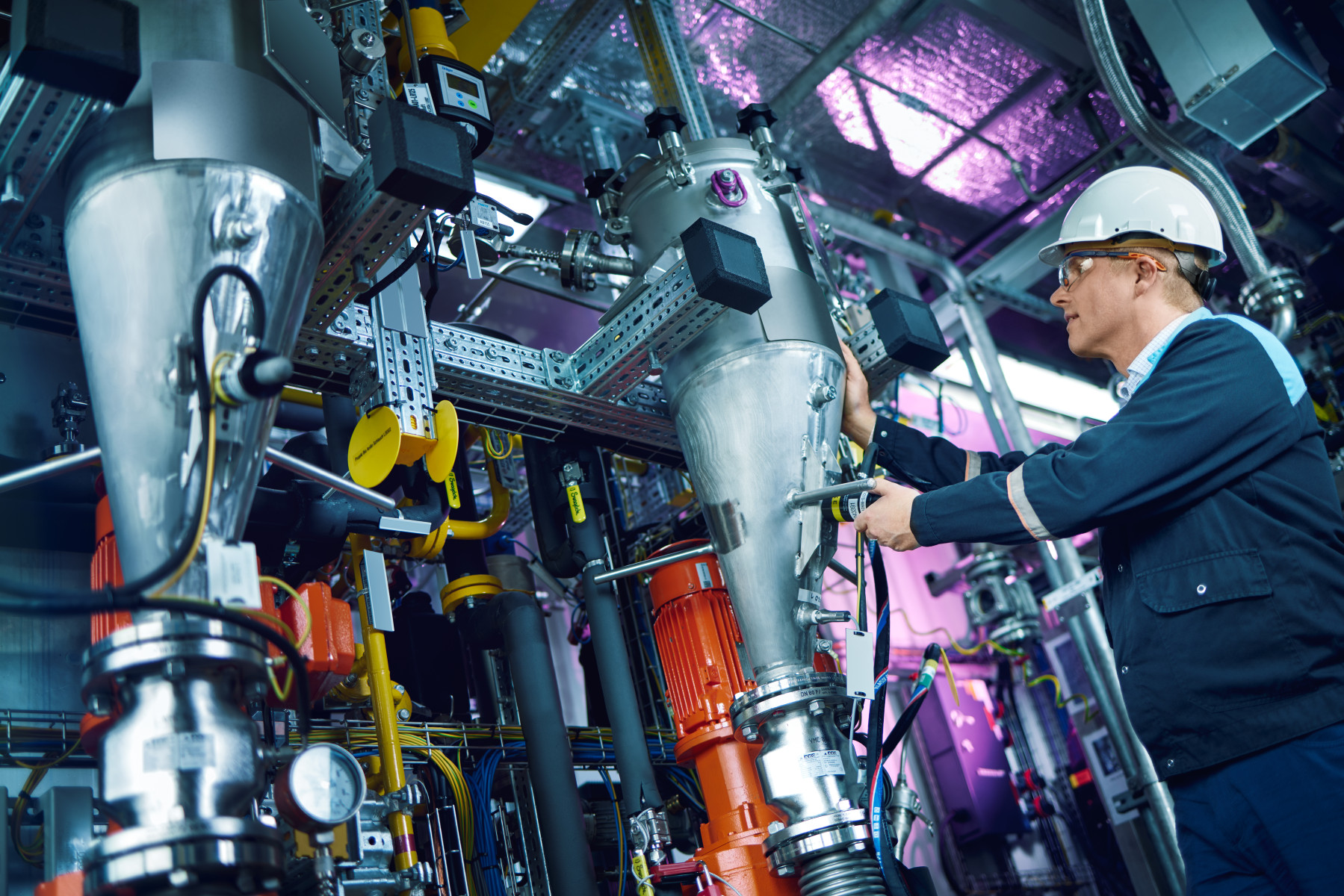
Covestro is moving forward with the implementation of a unique process for producing the important chemical aniline entirely based on plant biomass instead of petroleum for the first time. At its Leverkusen site, the plastics manufacturer has now put a special pilot plant into operation for this purpose. Initially, large quantities of bio-based aniline will be produced there, so that the new technology can be further developed for production and transferred to an industrial scale. In the plastics industry, aniline is used to produce MDI, among other things. This in turn is used for insulating foam, for example, which saves energy in buildings and reduces the CO2 footprint. Covestro believes it will contribute to the promotion of the Circular Economy, which the company is aiming to become fully aligned with.
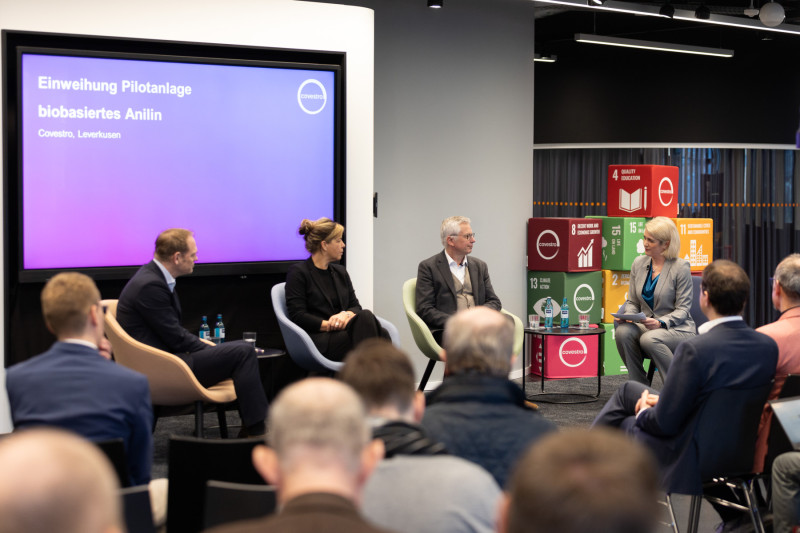
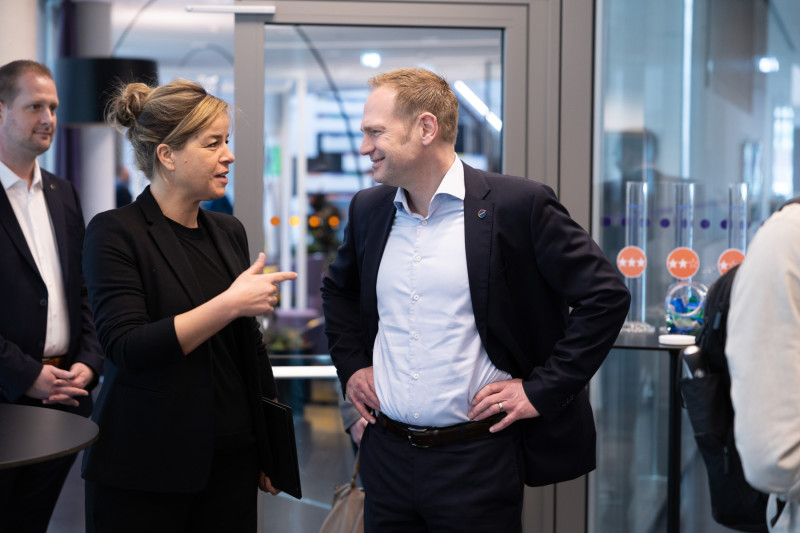
In attendance at the opening ceremony were North-Rhine Westphalia’s Deputy Minister President Mona Neubaur as well as Professor Walter Leitner, Managing Director of the Max Planck Institute for Chemical Energy Conversion in Mülheim an der Ruhr. Together with Dr. Thorsten Dreier, Chief Technology Officer of Covestro, they discussed the significance of bio-based raw materials for a sustainable chemicals industry of the future.
“Among other things, aniline is a key raw material for foams used to insulate buildings and refrigerators,” explained Dreier, on the significance of the base chemical. “Until now, aniline has been produced from fossil raw materials such as petroleum, which releases CO2 and fuels climate change. With our new process, we are contributing to building up a circular, bio-based economy, and I am very proud that we have now succeeded in making the jump to the next technological level.”
Covestro developed the process, which has already won several awards, together with partners in the scientific community. Compared to conventional technology, the process leads to a greatly improved CO2 footprint of aniline. Covestro has made a seven-digit investment in the pilot plant at the Chempark Leverkusen.
"Sustainable innovations from North Rhine-Westphalia are making a decisive contribution to the transformation of Germany as a chemical location. The world's first pilot plant for bio-based aniline is an impressive example of this," emphasized Neubaur, who is also the State Minister for Economic Affairs, Industry, Climate Protection and Energy. "In order for the industry to continue on its path towards a circular economy and climate neutrality, it needs planning and investment security above all. As the state government, we are therefore working hard to ensure that North Rhine-Westphalia remains an attractive business location and becomes the first climate-neutral industrial region in Europe."
Professor Leitner also underlined the importance of partnerships. “The project illustrates the cooperation between research-based industry and application-oriented science. There are many intersecting partnerships like these, especially in NRW. Germany needs more of this in order to assert itself as a research and technology location.”

Use of biotechnology
The project also clearly showcases the potential contribution of the industrial (“white”) biotechnology to plastics production: in the new process, a customized microorganism helps convert an industrial sugar extracted from plants into an intermediate product through fermentation. This takes place under milder and thus more environmentally compatible conditions than in conventional processes. In a second step, chemical catalysis of the intermediate product then creates the aniline with one hundred percent plant-based carbon.
The research on bio-based aniline will also continue to be funded by the German government. The German Ministry for Food and Agriculture is funding a follow-up project (Bio4PURDemo) from Covestro and partners, which started in March 2022 and runs until 2025.
The RWTH Aachen with the CAT Catalytic Center and the University of Stuttgart, as well as the technology transfer initiative located there, are also participating in the project.
Around six million tons of aniline are currently produced worldwide, with the volume growing by approximately three to five percent per year on average. With a production capacity of more than one million tons per year, Covestro is one of the leading aniline producers.
The Panelists
 Mona Neubaur, born in Pöttmes in 1977, came to North Rhine-Westphalia from Bavaria in 1997 and quickly made herself at home in the Rhineland. After graduating with a degree in education in 2003, she first worked in the energy industry and then at the Heinrich Böll Foundation NRW, including four years as Managing Director.
 Walter Leitner is Director at the Max Planck Institute for Chemical Energy Conversion in Mülheim/Ruhr and Professor of Technical Chemistry and Petrochemistry at RWTH Aachen University. He is one of the initiators of the Catalysis Center CAT, a joint research facility of RWTH Aachen University and Covestro.
 Dr. Thorsten Dreier has been a member of Covestro's Board of Management as Chief Technology Officer (CTO) since July 2023 and the company's Labor Director since September 2023. As the company's Chief Technology Officer, he is responsible for the central functions Process Technology, Engineering, Group Health, Safety & Environment (Group HSE) and Group Procurement. He also coordinates the introduction of and compliance with global processes, standards and initiatives in Covestro's production network.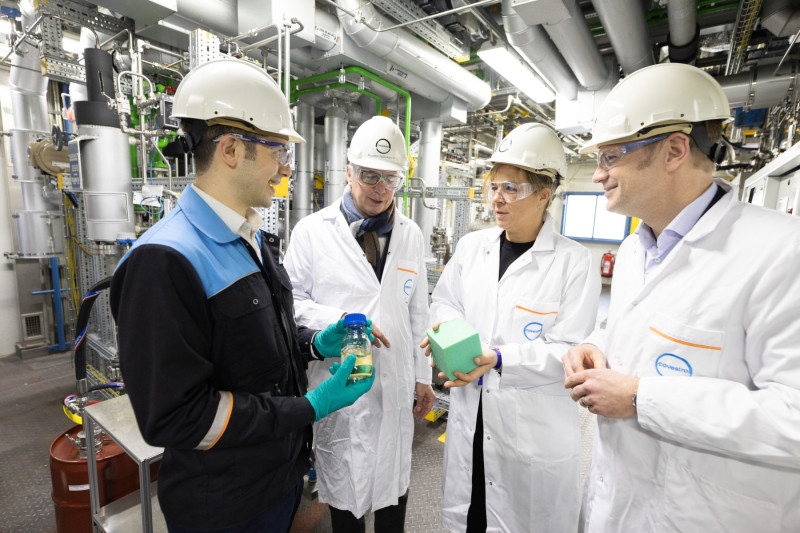




About Covestro:
Covestro is one of the world’s leading manufacturers of high-quality polymer materials and their components. With its innovative products, processes and methods, the company helps enhance sustainability and the quality of life in many areas. Covestro supplies customers around the world in key industries such as mobility, building and living, as well as the electrical and electronics sector. In addition, polymers from Covestro are also used in sectors such as sports and leisure, telecommunications and health, as well as in the chemical industry itself.
The company is geared completely to the circular economy. In addition, Covestro aims to achieve climate neutrality for its Scope 1 and Scope 2 emissions by 2035, and the Group’s Scope 3 emissions are also set to be climate neutral by 2050. Covestro generated sales of EUR 14.2 billion in fiscal year 2024. At the end of 2024, the company had 46 production sites worldwide and employed approximately 17,500 people (calculated as full-time equivalents).
Forward-Looking Statements
This news release may contain forward-looking statements based on current assumptions and forecasts made by Covestro AG. Various known and unknown risks, uncertainties and other factors could lead to material differences between the actual future results, financial situation, development or performance of the company and the estimates given here. These factors include those discussed in Covestro’s public reports which are available at www.covestro.com. The company assumes no liability whatsoever to update these forward-looking statements or to conform them to future events or developments.