





Important chemical based on biomass for the first time
If you want to make a difference to protect the climate and environment, you need ideas, courage and know-how, perseverance and like-minded people. At Covestro, everything has come together in a unique project. Together with partners, the company has developed a pioneering process for producing bio-based aniline. This basic chemical has long been very important in industry – as a raw material for plastics, paints and medicines. The disadvantage: So far it has been produced predominantly with fossil raw materials such as petroleum, which releases CO2 and fuels climate change.
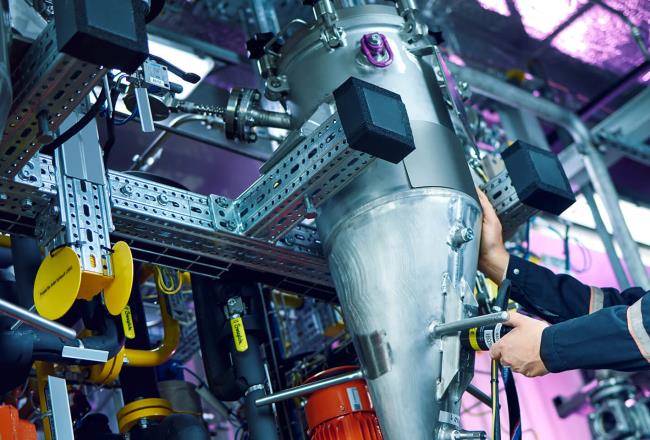
But there is also a more sustainable way. For the first time, the oil can be completely replaced by plant biomass. The research consortium led by Covestro has proven this. The new technology, which has been developed over years, has now reached an important milestone: It is being tested and further developed for production on an industrial scale in a special pilot plant at our Leverkusen site in Germany.

The process, which has already won several awards, leads to a significantly improved CO2 footprint of the aniline compared to conventional technology. Industrial (“white”) biotechnology also comes into play. A tailor-made microorganism helps convert an industrial sugar obtained from plants into an intermediate product through fermentation. In a further step, this is then converted into aniline, which consists of one hundred percent bio-based carbon. The new technology thus contributes to the circular economy, to which Covestro is fully aligned.
Research into bio-based aniline was supported by the German government. The Federal Ministry of Food and Agriculture provided funding to the project (Bio4PURDemo), which started in March 2022 and finished end of February 2025. Covestro has collaborated and continues to collaborate on this project with RWTH Aachen University, the University of Stuttgart, and the technology transfer initiative established there.
Covestro uses aniline to produce the substance MDI, which serves primarily as a component for the production of rigid polyurethane foam. The material is used worldwide to insulate buildings and cooling devices and thus makes a significant contribution to saving energy.