






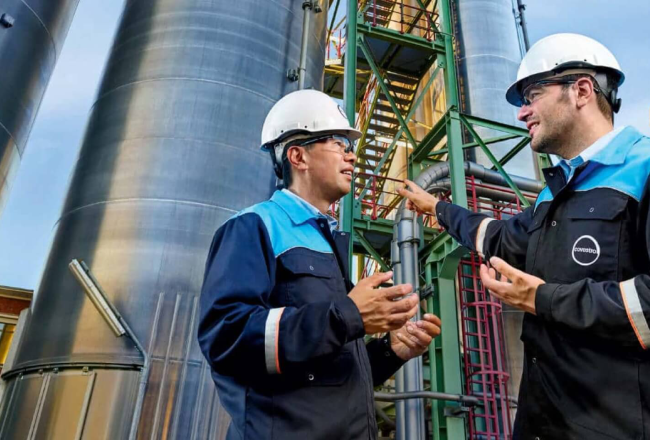
Our Comprehensive Energy Efficiency Strategy
Our commitment to energy efficiency is motivated by two key factors: our corporate vision to become fully circular and achieve climate-neutral production by 2035, and the economic imperative to remain competitive in international markets, considering that energy costs represent a substantial portion of our production expenses. We maximize energy efficiency through innovative approaches like waste heat recovery. Our guiding principle is simple: The best kilowatt-hour is the one we don't need at all.

“Climate-neutral production can only be achieved if we significantly reduce our energy requirements for the manufacture of our products. This is because there is currently not enough renewable energy available at affordable prices to even begin to cover demand.“

Targets, achievements and path forward
By 2030, Covestro aims to lower energy consumption per ton of product by 20 percent compared to 2020. This corresponds to a saving of around 550,000 tons of CO2 emissions.
Building on our long-standing commitment to energy efficiency, we have been actively implementing improvement measures well before setting this ambitious target.
We power our plants using innovative technologies, including our energy management system, which we developed and established in 2008. Today, we use it at our production sites all over the world. Our energy management system creates transparency and enables us to monitor energy consumption at individual production locations and optimize energy usage.
We foster a living energy efficiency culture and community as well as an idea portal that encourages employee participation. This provides a basis for sharing ideas and best practices worldwide and continuously pushing towards more efficient processes.
We have successfully implemented over 1,100 energy efficiency projects since the beginning of our program in 2008, resulting in substantial energy savings of 36 million MWh.
And with a reduction of 12.6 percent of energy consumption per ton of product compared to 2020, we have already achieved more than half of our 2030 target by 2025.
While we have a long track record and are proud of all we have achieved, we keep pushing forward to make the world a brighter place. We continuously expand our energy efficiency project portfolio through systematic analysis of our sites for heat integration potential, ensuring consistent implementation of heat integration within our processes and identifying opportunities at both plant and site levels.

Project examples
Innovative use of reaction energy for steam production (TDI)
In March 2025, we successfully put a new 150-ton, 20-meter-high reactor for hot phosgene generation into operation at our TDI plant in Dormagen that uses waste heat from production processes to generate steam for further manufacturing steps. The modernized plant achieves up to 80 percent reduction in energy consumption compared to conventional processes and reduces CO2 emissions by up to 22,000 tons per year – bringing us closer to our ambitious goal of achieving net-zero production by 2035.
The project, which ran from summer 2023 to March 2025, involved installing over 3.5 kilometers of new pipelines, 14 kilometers of cables, and hundreds of new equipment pieces. This modernization strengthens the competitiveness of European TDI production and demonstrates that climate protection and competitiveness can be achieved simultaneously.
Sustainable Chlorine Process (ODC Technology)
Around 60 percent of all chemical products are made, directly or indirectly, using chlorine and/or sodium hydroxide. One of the major challenges facing the chlorine-alkali industry is the large amount of energy used by salt electrolysis in the creation of chlorine and sodium hydroxide. To tackle this challenge, a team of chlorine chemists and engineers from Covestro and thyssenkrupp nucera AG & Co. KGaA developed a groundbreaking process that produces chlorine more sustainably: the Oxygen-Depolarized Cathode (ODC) technology. Compared to traditional chlorine processes, ODC technology uses up to 25 percent less energy and accordingly reduces CO2 emissions associated with electricity generation from fossil fuels.
Covestro built the first industrial-scale plant based solely on this state-of-the-art technology in Tarragona, Spain, putting it into operation in 2023.
Stories that push boundaries
Learn more about our technologies enhancing energy efficiency in our latest interview with DENEFF (available in German only), a German independent cross-sector network of pioneering companies advocating for effective energy efficiency policies in Germany and Europe since 2010.