






Glasgow university students sweep the board
Winner of ‘Design Innovation in Plastic 2024’ announced
- Winner creates self-powered cleaning device for feminine products
Students from the ‘Glasgow School of Art’ have filled the first three places in this year’s Design Innovation in Plastics (DIP) competition. DIP, which is supported by The Worshipful Company of Horners, the Institute of Materials, Minerals and Mining (IOM3) and sponsored by Covestro, is the longest running plastics design competition of its kind for university undergraduates in Europe. This year’s contestants were asked to design an off-grid product made primarily from plastics for independent living, aimed at either leisure or household markets.
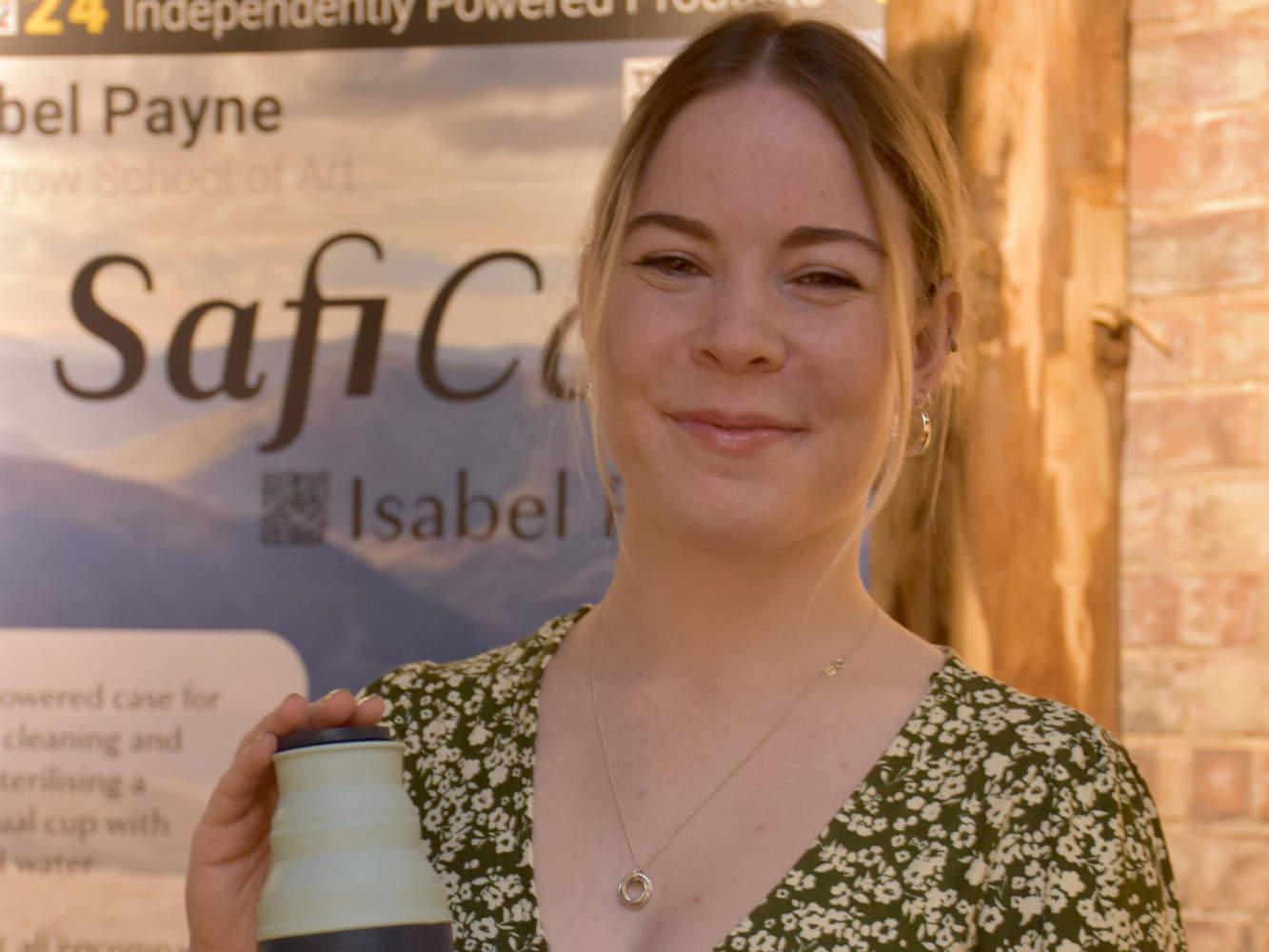
The first prize went to Isabel Payne, a Product Design Engineering student from the Glasgow School of Art. She created ‘SafiCase’ – a device for cleaning and steam sterilising re-usable menstrual cups using minimal water. The case is entirely self-powered, using a solar battery for the sterilising circuit. It is targeted at women who want something to use when they are nowhere near an electricity source or any running water. It is collapsible, so can be carried easily.
Chairman of judges, Richard Brown, said: “This is a great solution to safely clean a menstrual cup without power and to maintain hygiene. This product uniquely addresses the off-grid challenge and meets a very clear social need, not just for the traveller, but also, for example, displaced people. It was very well researched and is a worthy winner with a product idea that could be commercialised.”
Isabel said: “It means such a lot to have a platform for dealing with the issue of period poverty, which is rarely spoken about, despite affecting so many people worldwide and around 40 per cent of women in the UK. I hope this design helps bring awareness for reusable options and helps other people decide to invest time in designing more solutions, as there is very little innovation in this area.”
The judges awarded second place to Jake Lee (Product Design Engineering), also of Glasgow School of Art, for his product ‘SkinTemp’, a cold-water temperature sensor that alerts users to dangerous drops in body temperature. In third place was Glasgow School of Art’s Jem Mitchell, also a Product Design Engineering student, who produced ‘Sentree’, a solar powered sonic deterrent that protects trees from being overgrazed by animals such as deer.
Notes to editors
Established in 1985, Design Innovation in Plastics is the longest running student plastics design award in Europe. For more information visit www.designinnovationplastics.org.
The Institute of Materials, Minerals and Mining (IOM3) is a major UK engineering institution and is the professional body for the advancement of materials, minerals and mining to governments, industry, academia, the public and the professions. For more information visit www.iom3.org.
The Worshipful Company of Horners is one of the oldest livery companies in the City of London, formed to regulate the horn-working trade. In 1943 it adopted its modern equivalent, the plastics industry. For more information visit www.horners.org.uk.
About Covestro:
Covestro is one of the world’s leading manufacturers of high-quality polymer materials and their components. With its innovative products, processes and methods, the company helps enhance sustainability and the quality of life in many areas. Covestro supplies customers around the world in key industries such as mobility, building and living, as well as the electrical and electronics sector. In addition, polymers from Covestro are also used in sectors such as sports and leisure, telecommunications and health, as well as in the chemical industry itself.
The company is geared completely to the circular economy. In addition, Covestro aims to achieve climate neutrality for its Scope 1 and Scope 2 emissions by 2035, and the Group’s Scope 3 emissions are also set to be climate neutral by 2050. Covestro generated sales of EUR 14.2 billion in fiscal year 2024. At the end of 2024, the company had 46 production sites worldwide and employed approximately 17,500 people (calculated as full-time equivalents).
Forward-Looking Statements
This news release may contain forward-looking statements based on current assumptions and forecasts made by Covestro AG. Various known and unknown risks, uncertainties and other factors could lead to material differences between the actual future results, financial situation, development or performance of the company and the estimates given here. These factors include those discussed in Covestro’s public reports which are available at www.covestro.com. The company assumes no liability whatsoever to update these forward-looking statements or to conform them to future events or developments.