
Covestro and Fraunhofer UMSICHT turn end-of-life vehicle waste into basic chemicals
- CARBEX project develops low-carbon process to produce BTEX aromatics from automotive shredder residue
- Fraunhofer UMSICHT’s patented technology offers an alternative to steam cracking fossil-based naphtha
- Up to 40% lower emissions – with the potential to reduce CO₂ emissions in Germany by up to 640,000 metric tons per year
- Scale-up to continuous pilot-scale operation planned by 2028
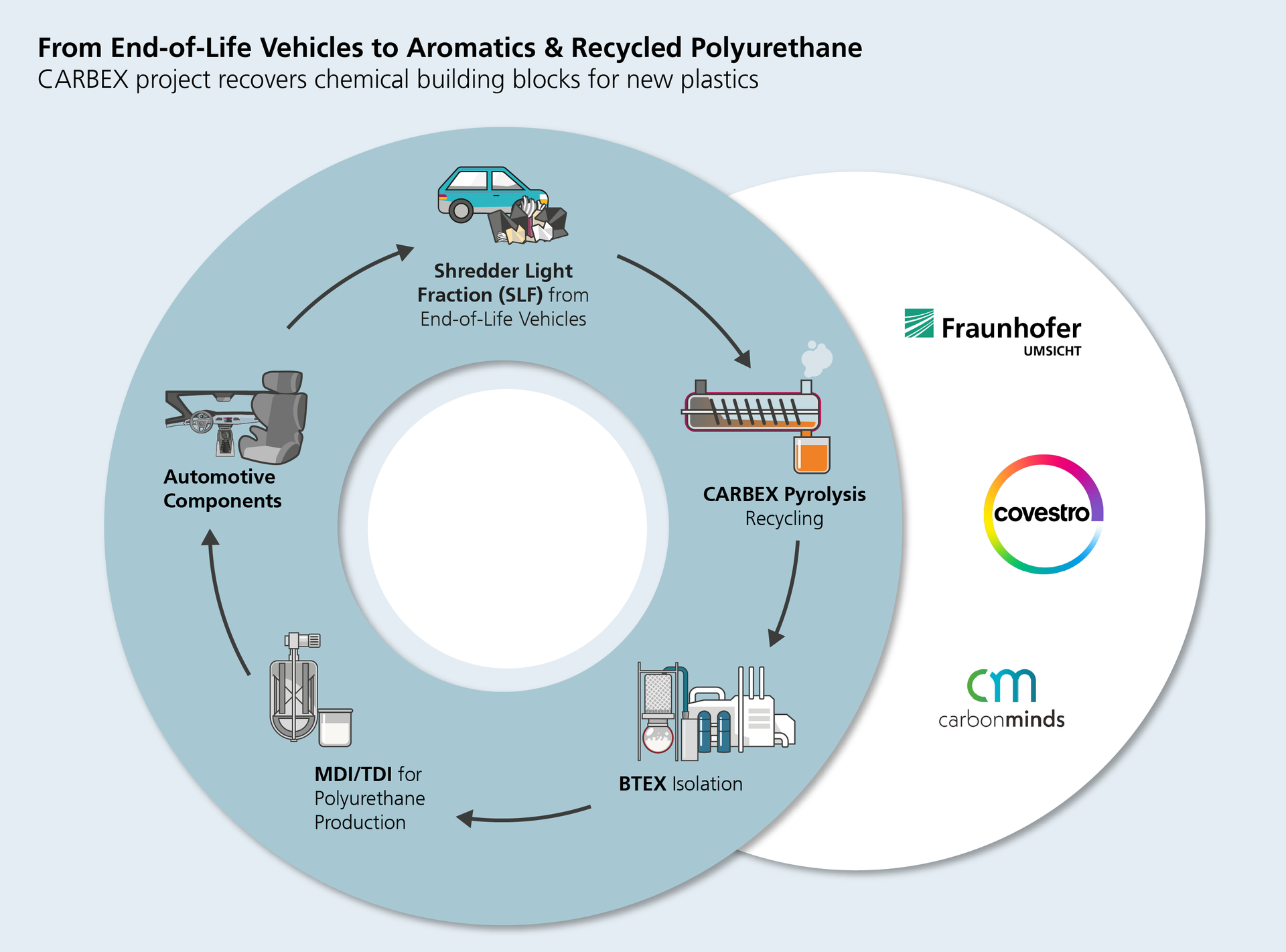
Covestro, the Fraunhofer Institute for Environmental, Safety and Energy Technology UMSICHT, and Carbon Minds GmbH have launched the CARBEX research project. The joint project aims to validate a recycling process for recovering the aromatics benzene, toluene, ethylbenzene and xylenes (BTEX) from automotive shredder residue (ASR) – a waste stream from automotive recycling that is still largely incinerated today. Covestro is leading the project’s industrial activities.
BTEX aromatics are essential building blocks for the chemical industry. Covestro uses benzene as a feedstock to produce MDI (methylene diphenyl diisocyanate) and toluene to produce TDI (toluene diisocyanate). MDI is used, for example, to make insulation foams for buildings and refrigerators, as well as structural and acoustic components for vehicles. TDI is used to produce flexible foams for mattresses, upholstered furniture and car seats.
At the end of a vehicle’s life, components like these, which contain significant amounts of polyurethane, can end up back in automotive shredder residue. This means CARBEX could help close the loop in automotive recycling.
“With CARBEX, we are tapping into a source of carbon that is currently mostly burned,” says Dr. Stefanie Eiden, Project Manager at Covestro. “If we can recover benzene and toluene from automotive shredder residue at the quality required for our MDI and TDI production processes, we can close a material loop while replacing an emissions-intensive step in the production of basic chemicals.”
Aromatics are mainly produced today through the steam cracking of fossil-based naphtha. In Germany alone, this process generates around 8 million metric tons of CO₂e in direct process emissions every year, in addition to approximately 11 million metric tons associated with crude oil extraction and naphtha production.
At the same time, more than 466,000 metric tons of automotive shredder residue (ASR) are generated in Germany each year. Around 210,000 metric tons are used for energy recovery or disposed of. On average, polyurethane accounts for 20% of this waste stream by weight, although the share can vary significantly depending on its source.
Pyrolysis coke becomes a catalyst
CARBEX is based on Fraunhofer UMSICHT’s patented Pyromat technology. It combines pyrolysis with a subsequent autocatalytic reforming process, in which the pyrolysis coke generated during the process itself is used as both a catalyst and an adsorbent.
At temperatures of around 500°C, components of the coke such as calcium carbonate, titanium dioxide and copper promote the formation of aromatic compounds. At the same time, they bind halogens such as chlorine and bromine, preventing them from entering the pyrolysis oil. This eliminates the need for an expensive external catalyst, which would quickly lose its effectiveness due to contaminants in real-world waste streams.
In preliminary laboratory-scale tests using automotive shredder residue (ASR), Fraunhofer UMSICHT achieved a BTEX content of 62% by weight in the pyrolysis oil – around 60% higher than in conventional pyrolysis oils – and reduced the halogen content by up to 99%. According to the institute’s calculations, process-related emissions from the Pyromat process amount to around 1.1 metric tons of CO₂e per metric ton of BTEX, almost 40% lower than the 1.6 to 1.8 metric tons associated with steam cracking.
“The Pyromat technology uses pyrolysis coke as both a catalyst and an adsorbent. This makes the process robust and cost-effective, especially when dealing with highly contaminated waste streams,” explains Dr. Thomas Fehn, Project Manager at Fraunhofer UMSICHT’s Sulzbach-Rosenberg branch. “As part of the project, we are taking this approach from the laboratory to continuous pilot-scale operation at a throughput of 10 kilograms per hour.”
According to market studies, widespread industrial adoption of the process could reduce CO₂e in Germany by up to 640,000 metric tons per year. It would also reduce raw material-related emissions by replacing fossil-based naphtha.
From waste to isocyanates
CARBEX covers the entire value chain, from BTEX production to its use in industrial applications. Fraunhofer UMSICHT is adapting its existing pyrolysis plant, converting a fixed-bed reactor into a moving-bed reactor and identifying stable operating conditions. The aim is to produce at least 50 kilograms of BTEX-rich pyrolysis oil with halogen levels below 30 ppm – the threshold for further processing in large-scale industrial plants.
Covestro is developing a model-based separation process to recover the individual aromatics benzene and toluene from the pyrolysis oil through distillation. It will then validate their suitability for use in MDI and TDI production and carry out a techno-economic assessment. As an independent partner, Carbon Minds GmbH is responsible for the ISO-compliant cradle-to-gate life cycle assessment (LCA) of the new value chain.
Closing material loops and meeting recycling targets
The potential is significant. Industry analyses show that more than 2.6 million metric tons of aromatics are produced in Germany every year, with a market value of around €1.95 billion. At the same time, regulatory requirements for recycling are becoming stricter. For example, the EU End-of-Life Vehicles Regulation (ELVR) will introduce mandatory recycled-content targets for plastics used in vehicles from 2032. Part of the recycled material will have to come from end-of-life vehicles. Polyurethane chemically recycled through the CARBEX process could help meet these requirements.
The CARBEX project (September 2026 to August 2029) is funded by the German Federal Ministry of Research, Technology and Space under its “Avoiding Climate-Relevant Process Emissions in Industry” (KlimPro-Industrie II) funding program.
About Covestro:
Covestro is one of the world’s leading manufacturers of high-quality polymer materials and their components. With its innovative products, processes and methods, the company helps enhance sustainability and the quality of life in many areas. Covestro supplies customers around the world in key industries such as mobility, building and living, as well as the electrical and electronics sector. In addition, polymers from Covestro are also used in sectors such as sports and leisure, telecommunications and health, as well as in the chemical industry itself.
The company is geared completely to the circular economy. In addition, Covestro aims to achieve climate neutrality for its Scope 1 and Scope 2 emissions by 2035, and the Group’s Scope 3 emissions are also set to be climate neutral by 2050. Covestro generated sales of EUR 12.9 billion in fiscal year 2025. At the end of 2025, the company had 46 production sites worldwide and employed approximately 17,600 people (calculated as full-time equivalents).
About Fraunhofer:
With more than 30,000 employees across 74 institutes, the Fraunhofer-Gesellschaft, headquartered in Germany, is one of the world’s leading organizations for applied research.
The Fraunhofer Institute for Environmental, Safety and Energy Technology UMSICHT supports industry and society in the transition to a climate-neutral, circular economy. Its research focuses on the circular economy, green hydrogen, carbon management and local energy systems.
The Sulzbach-Rosenberg branch of Fraunhofer UMSICHT develops process engineering solutions that use alternative carbon sources such as plastic waste, composite materials and biogenic residues and waste to produce sustainable products and intermediates. These include next-generation biofuels, basic chemicals and functionalized biochars. With a focus on process and plant engineering, the institute supports its customers and partners from initial project ideas through pilot plants and demonstration facilities to market launch.
About Carbon Minds:
Carbon Minds GmbH is a data and consulting company focused on decarbonizing the chemical and plastics industries. Through its cm.chemicals platform, the company operates the world’s largest LCA database for chemicals and plastics, covering more than 1,500 products across over 190 regions. Its methods and data comply with ISO 14040/44 and ISO 14067 and are independently certified.
Forward-Looking Statements
This news release may contain forward-looking statements based on current assumptions and forecasts made by Covestro AG. Various known and unknown risks, uncertainties and other factors could lead to material differences between the actual future results, financial situation, development or performance of the company and the estimates given here. These factors include those discussed in Covestro’s public reports which are available at www.covestro.com. The company assumes no liability whatsoever to update these forward-looking statements or to conform them to future events or developments.