
Case study
TVH Parts chooses lower-emission Recticel insulation for EE retrofit
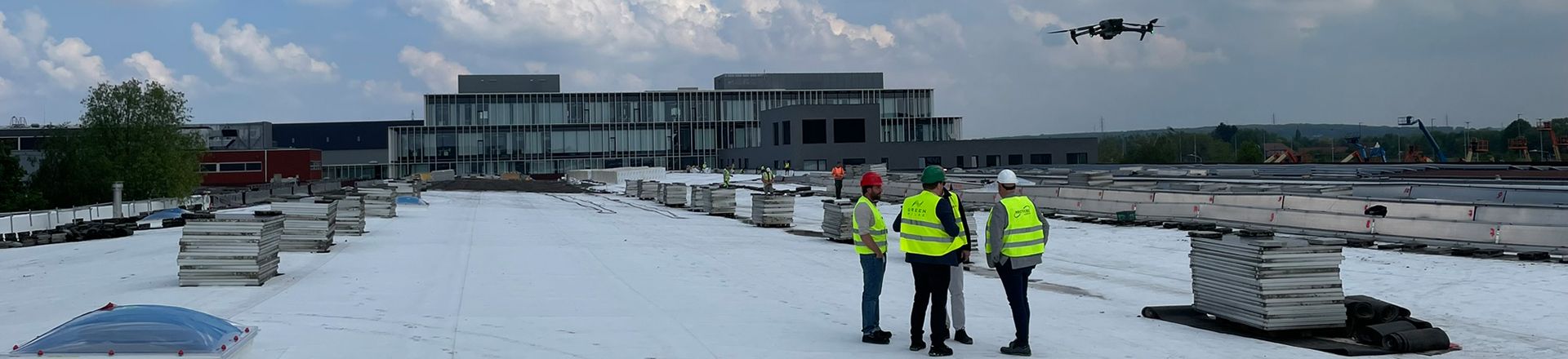
To retrofit a 10,000 m² flat roof, global industrial parts distributor TVH Parts selected Recticel’s Eurothane Silver Impact insulation board - achieving a 43% lower carbon footprint¹, thanks to our circular feedstock solution using bio-attributed Desmodur® CQ MS.
Case study · July 7, 2025
Lower-emission insulation board for an energy efficiency retrofit
Belgium-based TVH Parts, a global distributor of components for industrial, construction, and agricultural machinery, set out to upgrade one of its flat-roofed facilities as part of a major energy efficiency retrofit. The goal? To enhance insulation performance while integrating solar panels - without compromising on sustainability. So, the search for next-generation materials that could both improve energy efficiency and minimize environmental impact was on.
High insulation performance with lower carbon footprint
In Europe, creating new net zero buildings2 and renovating existing structures are both key in reaching climate neutrality3. Recticel is a producer of PU foam insulation that shares our vision of more sustainable building practices. The technical challenge was to provide them a lower-carbon emission MDI circular feedstock with the same performance as fossil-based materials. To minimize the carbon footprint, we used an ISCC-certified mass balanced MDI to allocate bio-circular inputs to the insulation. Achieving high thermal performance while reducing embodied carbon emissions is no small feat. Across Europe, retrofitting existing buildings is just as vital as constructing new net zero ones. That’s why TVH Parts turned to Recticel, a leader in PU foam insulation and a partner in climate-conscious construction. The technical challenge lay in designing an insulation board with circular MDI that is lower in carbon emission that could match the thermal capabilities of its fossil-based counterparts.
TVH Parts needed innovative building solutions to cut energy use in retrofitting a flat-roofed facility. Our lower-emission Recticel Impact insulation boards deliver 43% lower CO₂ emissions and high thermal performance - ideal for such projects. The roof insulation was expertly installed by Mutec.
Geert Dekyvere
Business Development Manager, Recticel
Desmodur® CQ MS enables Recticel cut CO₂ emissions by 43% in insulation boards
Recticel delivered – by using our Desmodur® CQ MS, a climate-neutral MDI that forms the core of Recticels Impact insulation boards. These boards offer the same high performance as traditional options but with a 43% lower carbon footprint, thanks to a 25% share of bio-circular attributed content and ISCC-certified mass balance feedstock. The result is a roof that helps TVH Parts to curb energy loss while contributing meaningfully to the facility’s overall sustainability profile.
Green buildings and energy-efficient construction are essential to achieving climate neutrality in Europe’s building sector. With Desmodur® CQ MS, our climate-neutral MDI, Recticel’s Impact insulation significantly reduces the embodied carbon of rigid PU/PIR insulation solutions.
Fernando Resende
Marketing Manager Building & Construction, Covestro
1 Emissions reduction based on internal LCA calculations from Recticel, stages A1-A3 (cradle-to-gate) according to the EN15804+A2 standard using a mass balance approach 2 A net-zero energy building (NZEB) is a structure that generates as much energy as it consumes over a year. 3 Climate neutrality is the result of a Covestro internal assessment based on TÜV reviewed EcoPAss LCA method (ID No. 0000083440), of a partial product life cycle from raw material extraction (cradle) to the factory gate (of Covestro), also known as cradle-to-gate assessment. The calculation takes into account biogenic carbont sequestration based on preliminary dat from the supply chain. No compensation measures were applied. 4 Allocation of bio-circular content via mass balance approach. Internal calculation from Recticel.
Key benefits
Fast:
Lower-emission MDI is available for integration into production flows immediately.
Effective:
Lower-emission insulation offers the thermal performance of traditional PUR/PIR.
Lower CO₂ emissions:
Climate neutral MDI significantly cuts CO₂ emissions in insulation materials.
Seamless:
Circular feedstocks can be dropped into existing formulations and processes.
Adaptable:
More sustainable PU foam supports gradual product changes to meet climate goals.

Desmodur® CQ MS in low-carbon insulation
Recticel Impact insulation based on Desmodur® CQ MS climate-neutral MDI lowers CO₂ emissions by 43%.
Related articles



Contact us